
Acme Bank, a fictional lender, has built AI agents that handle the work and the handoffs at each stage of a mortgage, from application intake to closing. When a borrower applies, the bank creates a dedicated Box folder for the application, and the borrower uploads supporting documents such as pay stubs, bank statements and tax forms into it. From there, the bank’s processors, risk assessors, underwriters and closers use agents for the checking and cross-referencing that used to be manual. Each loan moves through its stages faster, and each person starts from a prepared report.
The agent fleet
Four agents work alongside people to take a loan from open to close. An agent starts when a file or report lands in a folder. It does the work that used to take hours and writes its findings back to Box for the person who owns that stage. That person reviews the report and makes the approval or lending decision. Here are the four, in the order a loan reaches them:
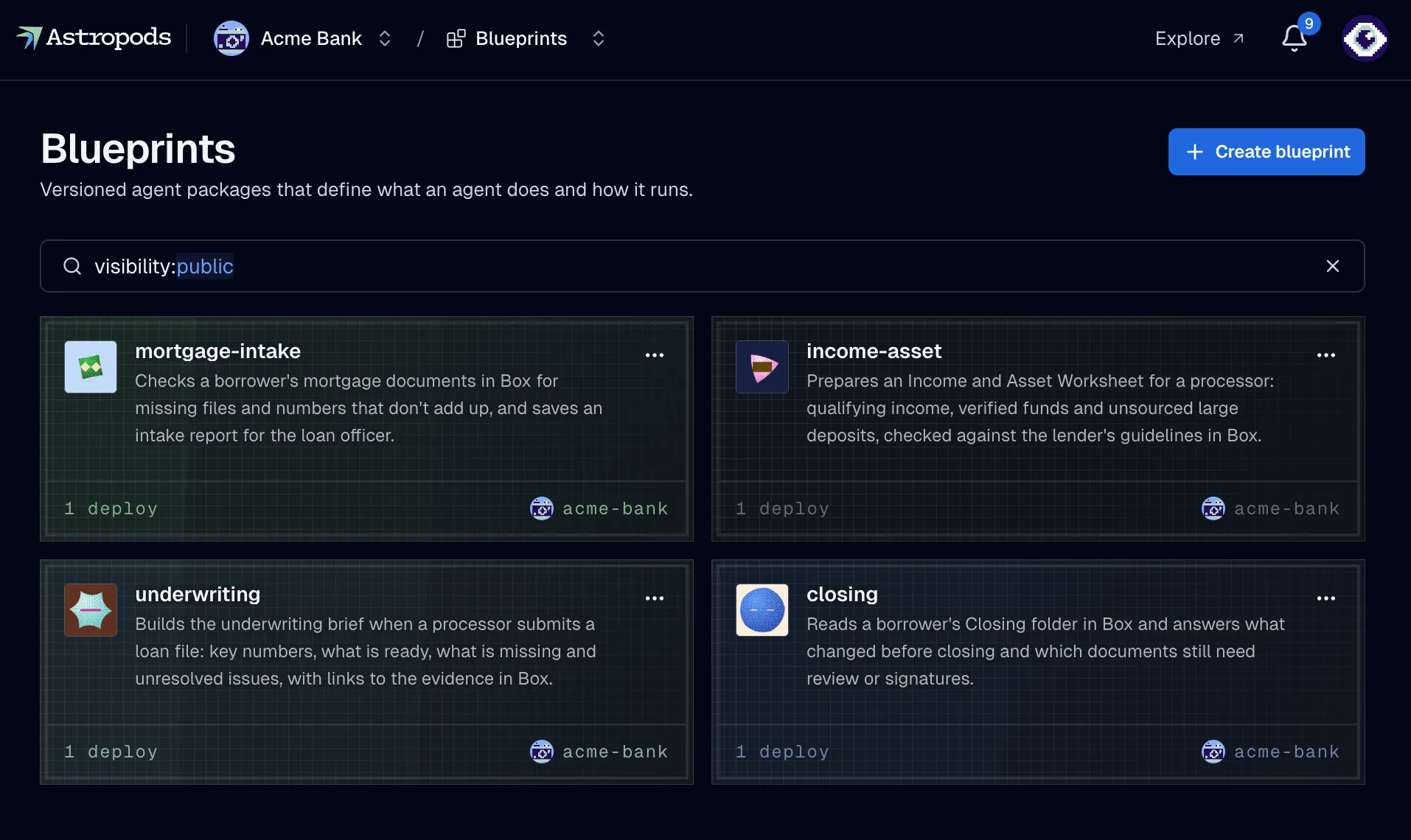
- Mortgage Intake. Checks a borrower’s documents for missing files and numbers that don’t add up, and saves an intake report for the loan officer.
- Income Asset. Prepares the Income and Asset Worksheet for a processor: qualifying income, verified funds and unsourced large deposits, checked against the lender’s guidelines in Box.
- Underwriting. Builds the underwriting brief when a processor submits a loan file, covering key numbers, what is ready, what is missing and which issues are unresolved, with links to the evidence in Box.
- Closing. Reads a borrower’s Closing folder in Box and answers what changed before closing and which documents still need review or signatures.
Blueprints: an inventory and lifecycle record for every agent
Each of the four agents is published as an Astropods blueprint, shown below. A blueprint is a versioned package that defines what an agent does and how it runs.
Agents get built quickly and by many people, so it is easy for an organization to lose track of them. A bank cannot accept that. Before an agent that reads loan files goes live, someone has to be able to say who wrote it, who looks after it and what it affects. The blueprint holds those answers and serves as the inventory record for the agent across its whole life. It tells you:
- Who built the agent, and who maintains it today?
- How is it built, including the framework and model it runs on and the tools it can call?
- Who scans it for vulnerabilities, and what did the last scan find?
- Which internal systems does it connect to, and which credentials does it use?
- Which version is running, and where is it deployed?
Take the closing agent, which reads every borrower’s Closing folder. The bank’s security team can open its blueprint and see the owner, the connections and the scan history before approving it. Each deployment traces back to a blueprint version, so when a vulnerability turns up, the bank can tell which agents it affects.
Developers code the agent using a framework of their choice, and publish it as a blueprint. Ownership, connections and versions are then managed in one place, outside each agent’s own code.
The agent fleet in action
Turning mortgage documents into structured data with Box AI Extract
The agents hand W-2s, pay stubs, bank statements and loan disclosures to the Box AI Extract API, which returns structured fields such as borrower name, annual income, account balance, down payment and document period.
Box AI extracts the facts and Claude turns the findings into reports. Deterministic rules in code decide which abnormalities get flagged.
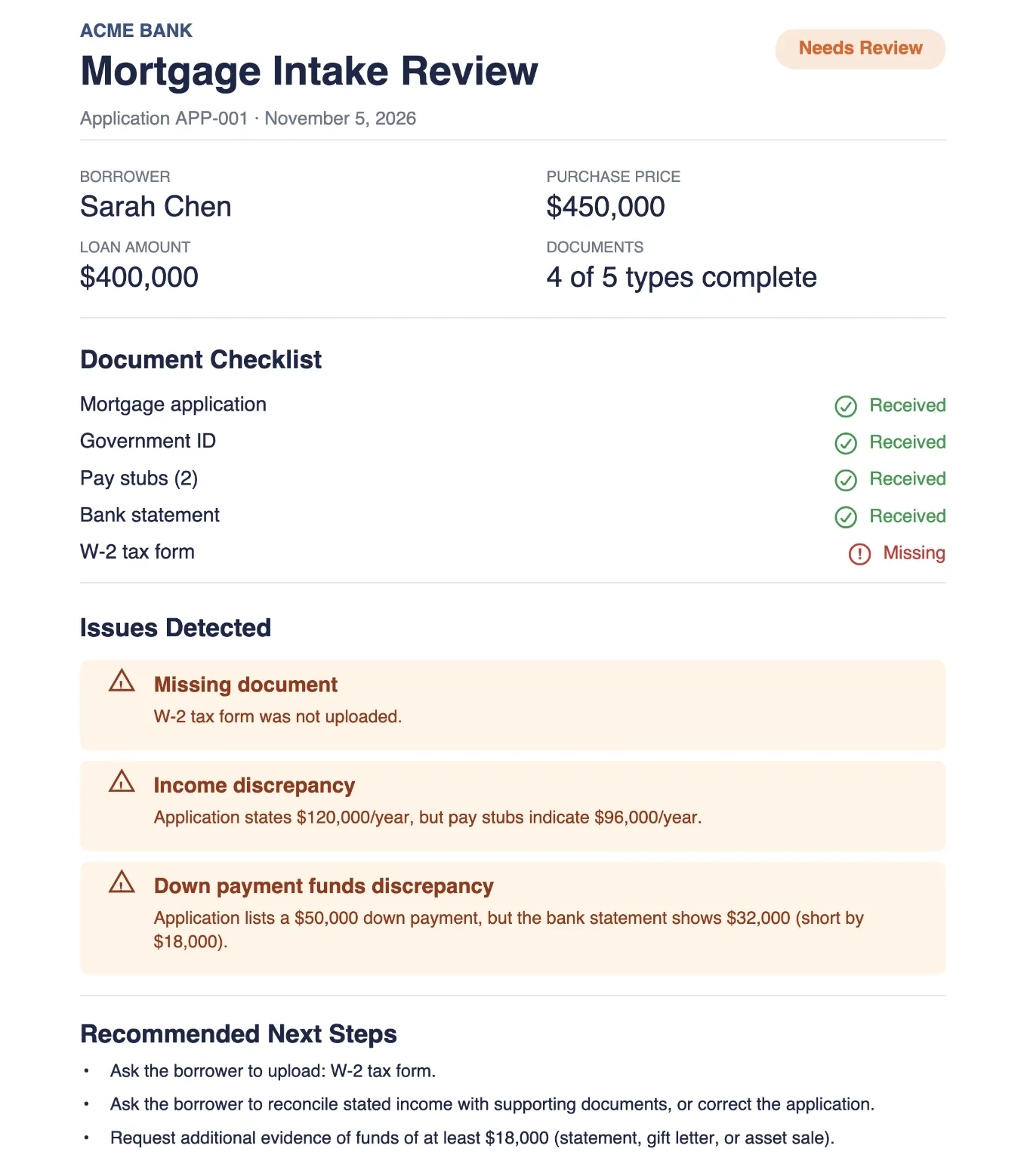
In the demo, the intake agent marks Sarah Chen’s application as Needs Review for three reasons: her W-2 is missing, her application states $120,000 in annual income while her pay stubs support only $96,000, and her $50,000 down payment exceeds the $32,000 documented balance. The agent then publishes a Mortgage Intake Review report to the Agent Reports folder in Sarah’s Box folder.
Why Astropods
Acme Bank’s agents run on two layers. Box is the secure content layer and document intelligence: it holds the application folders and understands what’s in them. Astropods is the agent infrastructure on top, where agents are packaged, deployed, connected to Box, coordinated and monitored.
The bank needs that second layer because agents need a common home. Without one, every team builds its own, and the bank ends up with agents it can’t inventory or audit. Astropods provides the essentials out of the box:
- A place to run. One runtime for every agent, so teams spend their time on the agent itself.
- Access control. Who can use which agent, and what each agent can reach, is set in one place.
- Policy enforcement. Guardrails apply to every agent automatically.
- Audit trails. Every action an agent takes is recorded, so the bank can show what happened and why.
- A feedback loop. Builders get historical production data, so agents improve from real behavior.
Astropods Connectors: use Box without putting credentials in every agent
Agents that touch borrower files need real access to Box, and the way they get it decides how secure the agent is and how quickly it can be shut down. The common shortcuts are shared service accounts and credentials copied into each agent. Both are hard to audit and cannot be scoped to a person, which leaves no clean way to cut off a single misbehaving agent. A Connector ties access to the user and manages it in one place. Developers never handle credentials, and the bank can trace anything an agent did back to the person whose access it used. If an agent goes rogue, disconnecting the Connector works as a kill switch.
All four agents use the Astropods Box Connector.
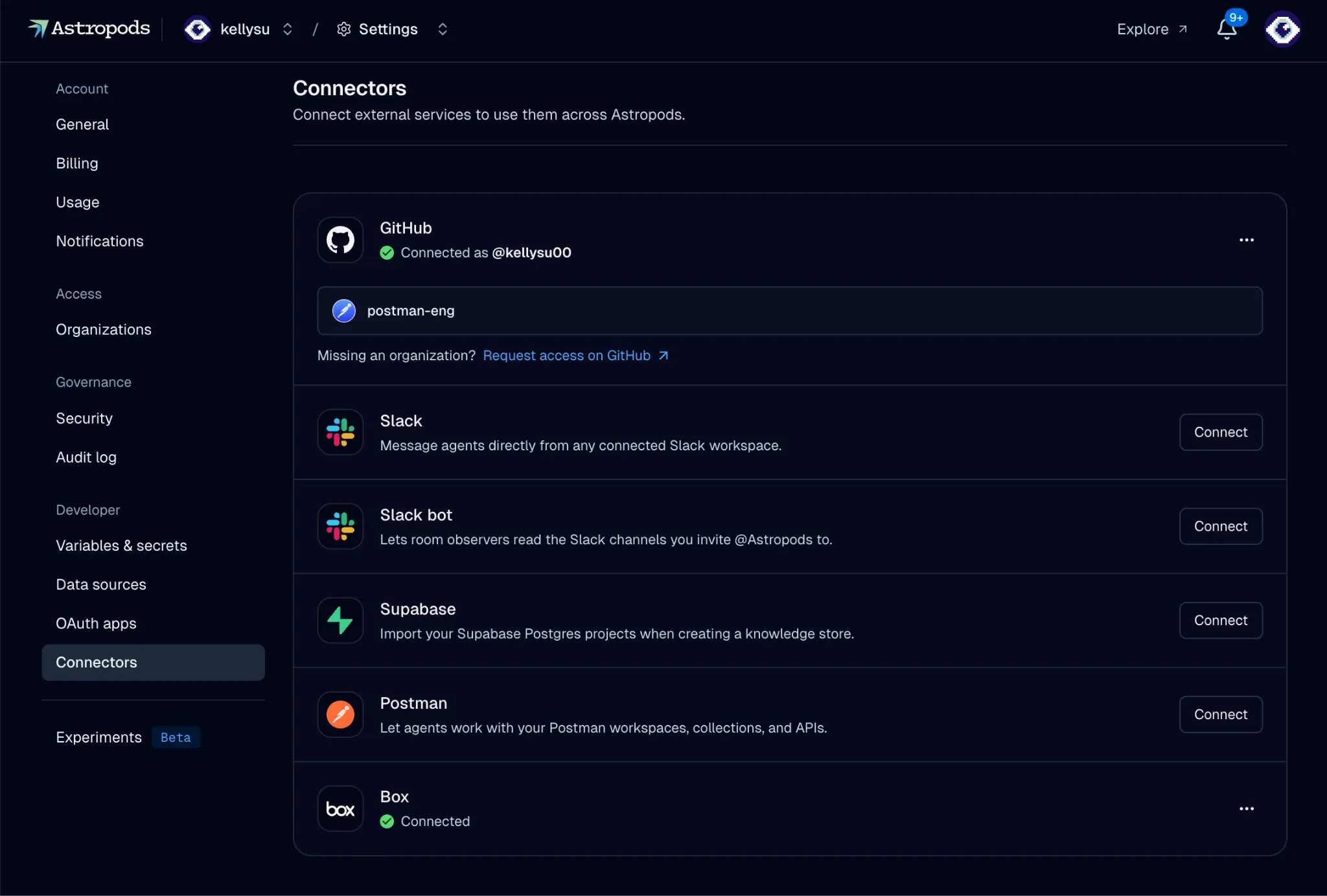
The user connects their Box account once in Astropods and explicitly allows an agent to use it. During an active interaction, the agent receives a short-lived token for that user and acts with that user’s existing Box permissions. Each agent declares the same Box Connector and Astropods manages it centrally, so the team distributed no Box credentials across the four agents and wrote no separate authentication flow for each blueprint. The Box permission model carries through: if the user cannot open a borrower folder, the agent cannot open it either. Access can be reviewed or revoked from the Connectors settings.
Coordinating agents and people
The four agents need to work together the way the people at the bank do. An application moves from intake to processing to underwriting to closing, with a handoff and a sign-off at each step. Agents that each work alone cannot reproduce that. Something has to read what each agent produced and decide who gets the work next. Two building blocks handle this, a judge and an overseer.
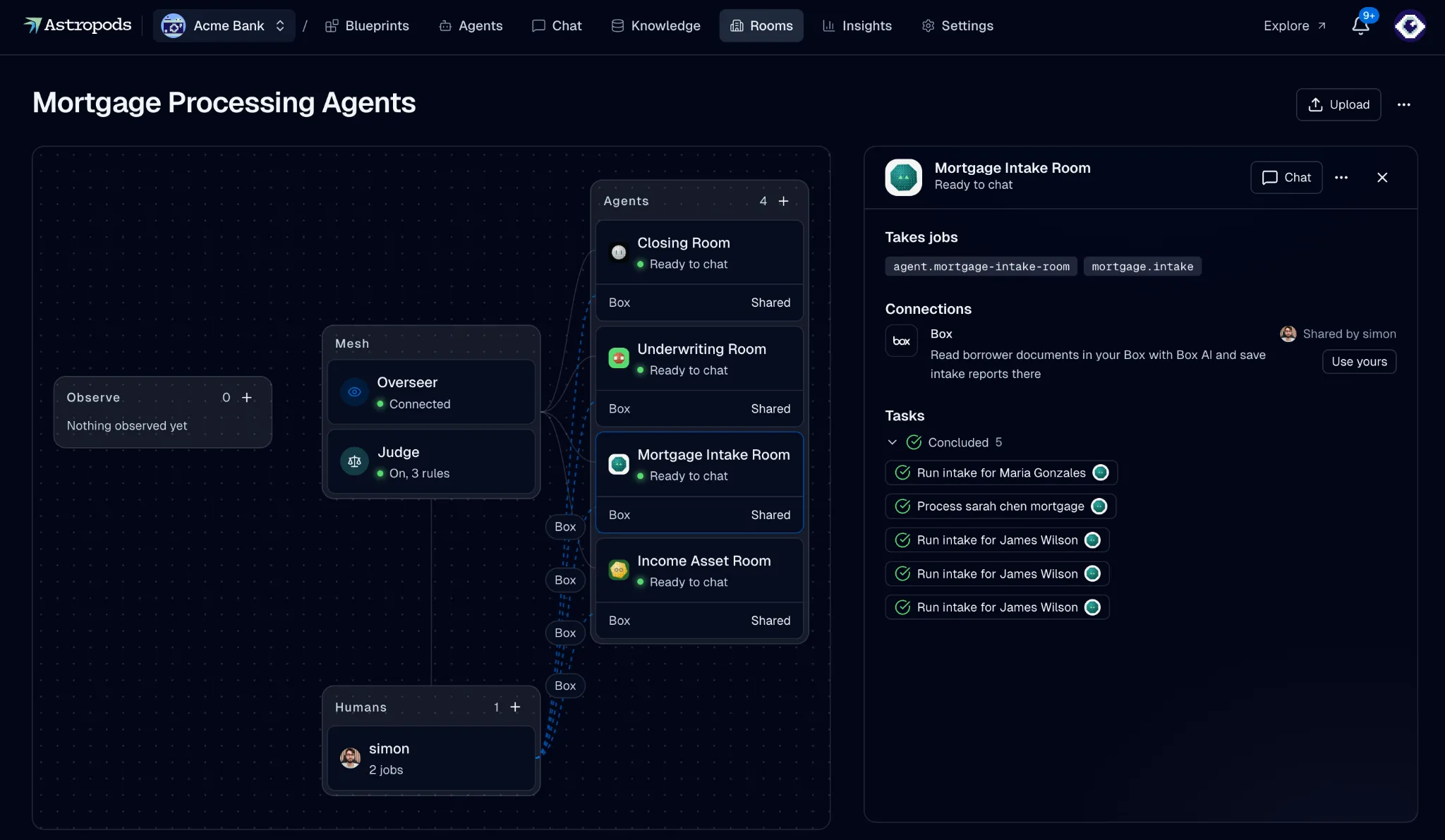
The judge reads each agent’s result and decides what it means. Every agent opens its result with a predictable status line, such as “Intake status: COMPLETE” or “Worksheet status: REVIEW.” The judge applies explicit rules to that status line, which makes routing consistent and explainable.
The overseer acts on the judge’s decision and hands the next task to the right agent or person. A complete intake starts the income and asset worksheet, and an intake issue goes to the processor for review.
People take part in the workflow as full participants. The processor and underwriter receive tasks just as the agents do, and sign-off and lending decisions belong to them alone. An agent can prepare the worksheet or the underwriting brief but cannot approve either.
In the demo, a second applicant, James Wilson, moves from intake to the worksheet, pauses for processor review and continues to the underwriting brief. Sarah Chen’s application stops with the processor right after intake, because her intake came back as Needs Review.
Astropods Insights: understand behavior, performance and cost
Once agents run in a real workflow, different people need different answers from the same data. Astropods Insights serves both from one place.
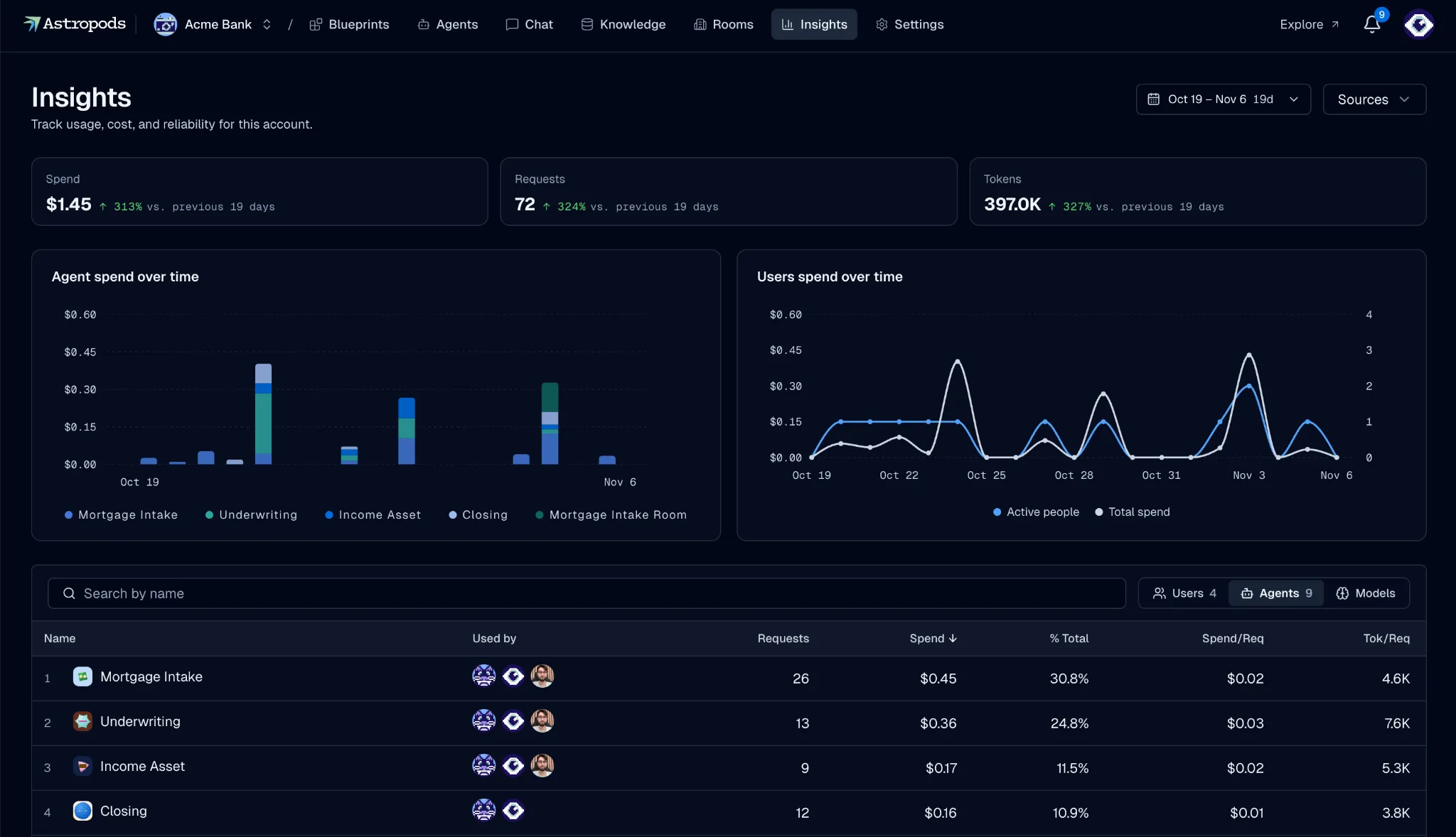
For the bank director: is it worth it? The director has to decide whether to keep funding the agents or retire them, and that is an ROI calculation. Astropods Insights supplies the inputs. As the agents run, Insights records usage and spend by agent and by model, so the director gets the numbers without a reporting project of their own. It answers:
- How many applications has each agent handled?
- Are people and agents working together, and if so who uses each agent and how often?
- What do the agents cost to operate, across infrastructure and AI tokens?
- Which agent drives most of the cost?
- What did the agents do on this loan, and what did it cost?
For agent builders: is it safe and getting better? Builders need to see inside a run. Astropods gives them that view without a separate observability system. The Astropods agent adapter records traces automatically to cover each model request and tool call. These form the basis for agent evals, which let builders test changes against real production behavior and keep operations safe. Together they answer questions like:
- Where did a failed loan run stop?
- Did a model call fail, or did a deterministic rule flag the application?
- Which Box tools did the agent call?
- How long does document extraction take?
Model choice and cost control
Different jobs call for different models. Extracting fields from a pay stub and explaining a discrepancy to an underwriter place different demands on a model, and models differ in cost and in how well they handle a given task. New models are also arriving often, so the right choice today may be the wrong one in a few weeks. A single model for every agent overpays on some steps and underperforms on others.
Box AI Extract exposes this choice directly. A team can pick from the models Box supports and override the default configuration upfront in the extract request, or give the agent instructions to make that choice at run time. For struct and table fields, Box recommends the Enhanced Extract Agent.
The Astropods AI Gateway makes it easier to route agents to different models. The model is chosen at deployment time, and no agent needs its own provider key, so nobody has to mint new keys each time a team wants to try another provider. Teams that prefer to bring their own provider credentials can do that and keep the same monitoring.
Picking the right model is a recurring job, and a hard one. Finding the cheapest model that still holds quality takes testing against real traces, and the answer varies as models and workloads change. That is barely manageable for four agents. As adoption grows and the fleet scales, people cannot keep up by hand, and the practical answer is agents that watch your agents. Insights gives people the spend and traces to start from. Astropods is heading toward pods that take on the rest, such as a cost optimizer pod that tries cheaper models and keeps the ones that maintain quality. The Astropods post Who looks after the agents? explains how pods work alongside people.
Try it
Astropods is both framework and model agnostic, so developers start with the tools they are familiar with, publish their agents as reusable blueprints, connect them to Box, then deploy and monitor their agents from one platform.
Box offers a free Developer plan for building, prototyping and testing. It includes Box API access, developer tools, monthly API capacity and Box AI Units, so developers can experiment with Box AI Extract and the Box MCP server without beginning in a production Box environment.
The source code and demo kit are available at github.com/astropods/box-agents.
The Astropods blueprints for Box are available at astropods.com/acme-bank.